Mercury Theater on the Air
How It Got on the Air
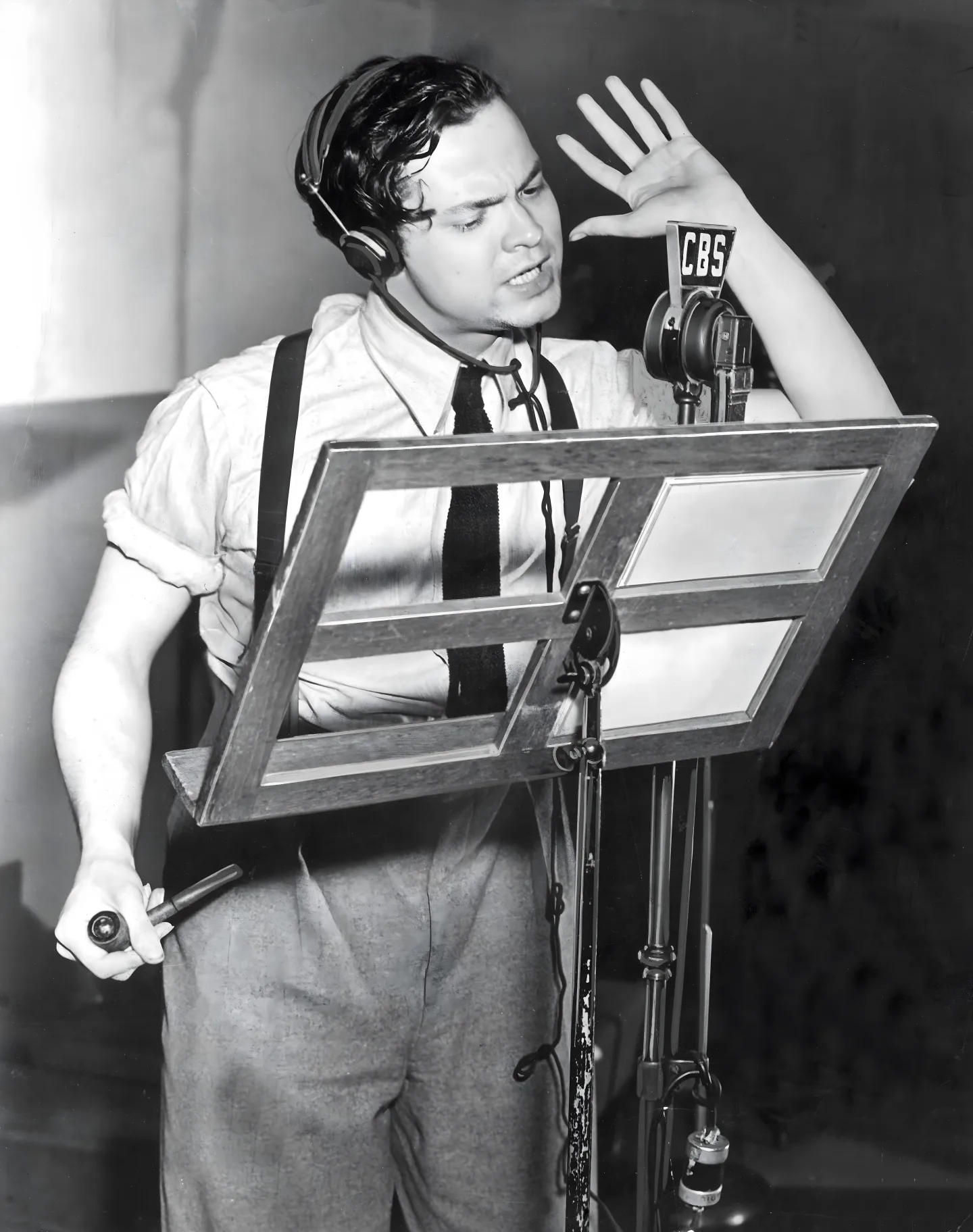
The Mercury Theater on the Air was born out of theatrical ambition, creative recklessness, and almost no preparation time. CBS approached Orson Welles in June 1938 with an offer of a timeslot, and when Welles and producer John Houseman said yes, they were told they'd be on the air in two weeks — on July 11 — with no play and no script ready. That combination of prestige booking and genuine chaos set the tone for everything that followed.
Welles had been a startling presence in the theater since he was old enough to walk a stage. Born in Kenosha, Wisconsin, on May 6, 1915, to a musician mother and an inventor-of-sorts father, he reportedly read the entire Shakespearean canon by the age of 10. At 12 he staged a school production of Julius Caesar and took three important roles himself. At 16 he was traveling through Ireland on a donkey cart, and in Dublin he bluffed his way into a substantial role in a Gate Theatre production of Jew Suss, earning notices that took him seriously as a professional. He picked up magic along the way and kept it as a lifelong hobby. By 1934 he was back in the United States, where a chance meeting with Thornton Wilder produced an introduction to Alexander Woollcott, who introduced him in turn to Katharine Cornell. Welles joined Cornell's road company in Romeo and Juliet and Candida, and later opened in Romeo in New York. Houseman saw him in that production late in 1934.
Houseman — born in Bucharest on September 22, 1902, 13 years Welles's senior — had made his own unlikely path to the theater. He'd spent years as a grain broker, following his father into the trade, until the Depression collapsed the export markets and left him looking for other work. His first real theatrical success came in 1934 with Virgil Thomson's opera Four Saints in Three Acts.
Their partnership accelerated through a series of increasingly audacious productions. Houseman had obtained the rights to Archibald MacLeish's play Panic and offered Welles the lead because he was struck by the dramatic timbre of Welles's voice. After Panic — which ran only three nights — Houseman became director of the WPA Negro Theater Project and brought Welles along. Together, at the suggestion of Welles's wife Virginia, they staged Macbeth as a jungle melodrama set in Haiti, drawing on the life of Henri Christophe, with voodoo drums and witch doctors replacing Shakespeare's original witches. It ran for weeks in Harlem.
The moment that crystallized the Welles-Houseman partnership — and effectively ended their government employment — came with Marc Blitzstein's The Cradle Will Rock in 1937. The show had deep anti-capitalist themes, depicting an industrial tyrant ruling a place called "Steeltown" and the fight of Labor against him. Less than three weeks before the June 16 preview, a sweeping WPA funds cut and a directive banning new openings threatened to kill the production. On June 15, a dozen uniformed guards sealed the theater and took up positions at the box office and in the alley, with orders to prevent the use or removal of government property.
What followed was genuinely improvised theater. The company retreated to the basement ladies' room and spent 24 hours on telephones. The union ruled its members couldn't perform on an alternate stage after being paid by the WPA, but Houseman argued that the wording "on stage" left the actors free, "as U.S. citizens," to enter a theater with the audience and speak their lines from the aisles. The Venice Theater, about 20 blocks away, was secured at nearly eight o'clock on opening night. Blitzstein played on a "rinky-tink" piano Houseman had obtained for the evening, and the production was performed from the aisles. It made front pages rather than theater pages. Houseman was formally dismissed from the WPA a month later, and a few days after that, Welles proposed they start their own theater.
The Mercury Theater opened on Broadway with a program of four productions, a company of 34, and a capital of $10,500. Welles and Houseman leased the Comedy Theater at Broadway and 41st Street. Their first show was Julius Caesar — staged as a modern allegory on fascism, with Welles playing Brutus in a blue serge suit on a stark stage. Time magazine called it "the brightest moon that has arisen over Broadway in years." By early 1938, Time had featured Welles on its cover.
By the time CBS came calling, Welles also had a substantial parallel career on the air. He was a regular on The March of Time and had assumed the lead in the Mutual Network melodrama The Shadow, earning roughly $1,000 a week from radio alone. CBS knew exactly what kind of voice and reputation it was buying.
First Person Singular: The Summer Run
The show's working title in its early promotional materials was First Person Singular — a phrase that captured Welles's approach. As he told Radio Guide: "The 'I' is more important in radio than in any other medium." The series was designed for "the listener alone," with no studio audience and no applause to disrupt the drama. It was believed to be the first time radio had offered a regular slot to an entire theatrical group.
CBS assigned Davidson Taylor as supervisor and Bernard Herrmann as musical director. Herrmann had joined CBS as a composer-conductor in 1934 after founding the New Chamber Orchestra in his early twenties and studying at New York University and Juilliard under teachers including Percy Grainger and Albert Stoessel. His working relationship with Welles was productive and stormy in equal measure — Houseman recalled "screaming rows," with batons snapped and thrown and scripts scattered across the studio floor. The opening theme was Tchaikovsky's Piano Concerto No. 1 in B-flat Minor.
The opener was Bram Stoker's Dracula — Welles had switched from the originally planned Treasure Island at the last moment, and he and Houseman worked on the script for 17 hours at Reuben's, a 59th Street restaurant that never closed. Welles played both Dracula and Dr. Seward; Martin Gabel played Van Helsing; George Coulouris played Jonathan Harker; Agnes Moorehead played Mina Harker. For the sound effects, the team tried a savoy cabbage and a sharpened broomstick to simulate a stake through the heart, but Welles rejected the result as "too leafy." A watermelon was approved, and Welles reportedly split it himself with a hammer during the session. Herrmann composed original music for Dracula — the only episode for which he wrote new material rather than arranging existing pieces, according to documents in the Bernard Herrmann Papers at the University of California, Santa Barbara. The press praised the premiere.
The cast Welles assembled around these shows reads now like a roster of future film talent: Ray Collins, Joseph Cotten, Everett Sloane, Paul Stewart, William Alland, Erskine Sanford, Agnes Moorehead, and others from the Mercury stage company. Dan Seymour announced. John Dietz engineered. Sound effects were handled by James Rogan, Ray Kremer, and Ora Nichols.
Houseman described the production pace as "soul-and health-destroying pressure," boiling down fat Victorian novels into 60-minute scripts in about three working days. The show ran unsponsored — what Houseman called "the golden years of unsponsored radio" — telling Harper's magazine there was no advertising agency or client to constrain them. CBS received high prestige and no income. The initial nine-week summer run was extended into the fall, and the show moved from Mondays at 9 to Sundays at 8, where it ran directly opposite Edgar Bergen's Chase and Sanborn Hour on NBC, the top-rated program of the era.
Howard Koch came to the Mercury looking for a writing job and was hired at $75 a week. His first script was Hell on Ice, an adaptation of Edward Ellsberg's book about George W. De Long's disastrous 1879 attempt to reach the North Pole — De Long's ship, the Jeannette, trapped in an icepack, a handful of survivors enduring two years of hardship. It aired October 9, 1938, and was the Mercury's only venture into documentary drama using a book published that same year.
The run between Dracula and Hell on Ice gives a fair sense of how wide a net the Mercury cast: A Tale of Two Cities, The Thirty-Nine Steps, and Count of Monte Cristo — for which Welles placed microphones against toilet bases and inside a toilet bowl with continuous flushing to achieve the sound of waves breaking against dungeon walls — alongside John Drinkwater's 1918 play Abraham Lincoln (August 15), Arthur Schnitzler's Anatol about a roué in pre-war Vienna (August 22, retitled The Affairs of Anatol), G.K. Chesterton's The Man Who Was Thursday, and the August 8 triple bill of Sherwood Anderson's "I'm a Fool," Carl Ewald's "My Little Boy," and Saki's "The Open Window." The fall season opened with a return to Julius Caesar, this time with newscaster H.V. Kaltenborn narrating to lend the broadcast a modern-day immediacy. A September 25 Sherlock Holmes drew on William Gillette's stage adaptation rather than the original Conan Doyle texts.
The Broadcast That Changed Everything
Welles decided in late October to air an adaptation of H.G. Wells's The War of the Worlds as a Halloween show. Some Mercury staff opposed the idea, thinking the 40-year-old story would be dated and dull. Koch's assignment was delivered six days before the October 30 broadcast date, with instructions to tell the story in a series of news bulletins with cutaways to first-person narrative.
What Koch realized almost immediately was that he could use very little of the source novel beyond the concept of a Martian invasion and descriptions of the Martians' appearance and machines — H.G. Wells had set the story in England, so the American version was essentially an original play. For a landing site, Koch opened a New Jersey road map, closed his eyes, and dropped his pencil. It landed on a village called Grovers Mill, surrounded by farmland. Koch described the name as having "an authentic ring."
By Tuesday, Koch was on the telephone to Houseman in despair, saying there was no way to make the show credible. Houseman's only short-notice alternative was Blackmore's Lorna Doone. He tried to reach Welles, who was rehearsing Danton's Death and would not take the call. When Houseman arrived at the office around 2 a.m., he found Koch in better spirits, "laying waste to the state of New Jersey." Koch particularly enjoyed including the destruction of CBS, where the last gasping announcer would call for survivors at the 40-minute break. Houseman and Koch finished the script at dusk Wednesday. A Thursday rehearsal in Welles's absence — run by associate producer Paul Stewart — was cut to a transcription and the crew judged it dull and unbelievable. They rewrote through the night and the following day.
The CBS censor reviewed the script Friday and required real locations to be replaced with fictional ones: the Hotel Biltmore became "the Meridian Room of the Hotel Park Plaza in downtown New York," and references to CBS became "Broadcasting Building." Welles had not seen the script or attended a single rehearsal as of Sunday morning. He appeared Sunday afternoon, took over from Stewart, and ran the final rehearsals himself.
Frank Readick, playing newsman Carl Phillips, spent hours listening to transcriptions of Herb Morrison's description of the Hindenburg disaster, absorbing Morrison's voice of distress. At broadcast time, Dan Seymour announced that The Mercury Theater on the Air was presenting the Orson Welles production of The War of the Worlds. Welles gave a short prologue setting the tale in the near future. Herrmann's musicians performed as "Ramon Raquello and his orchestra," opening with La Cumparsita before an early bulletin announced "explosions of incandescent gas, occurring at regular intervals, on the planet Mars." The next piece was Star Dust. Then reporter Carl Phillips went to the Princeton Observatory to interview Professor Richard Pierson — played by Welles. Then the Martians landed at Grovers Mill, where a shock "of almost earthquake intensity" had been recorded. Farmer Wilmuth was depicted as quite happy to talk about the fallen cylinder. Kenny Delmar played a character identified as the "Secretary of the Interior," who sounded enough like Roosevelt to disturb listeners. The first blast of the Martian heat ray was followed by dead air, then an ominous piano interlude — Clair de Lune. Ray Collins played the last announcer, describing the Martian machines wading the Hudson "like a man wading through a brook." The final voice in the Martian sequence was a shortwave operator repeating "2X2L calling CQ, New York . . . isn't there anyone on the air?"
At approximately the 40-minute break, Davidson Taylor was called away from the studio. He returned with what Houseman described as an ashen face, carrying orders to interrupt immediately and announce that the program was fiction. Welles had already reached the break. Dan Seymour stepped to the microphone: "You are listening to a CBS presentation of Orson Welles and The Mercury Theater on the Air in an original dramatization of The War of the Worlds, by H. G. Wells." Twenty minutes of straight drama followed, with Welles as Professor Pierson describing the Martian war's aftermath — the Martians killed by simple earth bacteria. Police swarmed into the studio at the broadcast's end and confiscated scripts.
Reports of the panic spread quickly. Men entered bars babbling about the end of the world. One Newark hospital treated 20 people for shock. A power shortage in a small midwestern town sent people into the streets. Students at a North Carolina college fought over telephones. In Boston, families gathered on rooftops imagining they could see New York burning. After the broadcast, Welles went to the Mercury Theatre where Danton's Death was in all-night rehearsal. Around midnight, he and the cast read the lighted bulletin on the New York Times Building: "ORSON WELLES CAUSES PANIC."
Princeton University commissioned a study of the broadcast's impact, published in 1940 by Hadley Cantril under the title The Invasion from Mars, funded by the Rockefeller Foundation. Cantril found that six million people had heard the broadcast, 1.7 million believed it to be authentic news, and 1.2 million were genuinely frightened. Contributing factors included the Munich crisis, which had conditioned listeners to real newsmen interrupting programming with breaking news. The War of the Worlds was the show's 17th episode, airing on a Sunday night opposite the top-rated Bergen-McCarthy program — a telephone survey of 5,000 households conducted that night found that only about 2 percent had tuned in to the Mercury broadcast.
Later scholarship complicated the picture considerably. American University media historian W. Joseph Campbell wrote in 2003 that "the panic and mass hysteria so readily associated with The War of the Worlds did not occur on anything approaching a nationwide dimension," quoting sociologist Robert E. Bartholomew on "a growing consensus among sociologists that the extent of the panic was greatly exaggerated." Michael J. Socolow of the University of Maine argued that newspapers amplified the panic story partly because radio had siphoned advertising revenue from print during the Depression, giving newspapers a motive to discredit radio as a news source. Frank Stanton, later president of CBS, stated simply: "In the first place, most people didn't hear [the show]." Of nearly 2,000 letters mailed to Welles and the FCC after the broadcast, roughly 27 percent came from frightened listeners or people who witnessed panic — a low total compared to other controversial radio broadcasts of the period. A. Brad Schwartz's Broadcast Hysteria argued that what panic did occur fed on widespread anxiety over the impending war and on Americans' fascination with the rapidly changing medium of radio itself. A Radio Project study found that less than a third of frightened listeners had understood the invaders to be Martians at all — most thought they were hearing reports of a German invasion. H.G. Wells himself, asked about the affair, responded that Mr. Welles's broadcast was "supposed to show the corrupt condition and decadent state of affairs in democracy."
Dorothy Thompson, after calling the broadcast unbelievable from start to finish, lauded Welles for demonstrating how vulnerable the country was to panic. Welles, at a press conference on October 31, said "Definitely not" when asked if he had anticipated the terror. He later described the broadcast as "The Mercury Theater's own radio version of dressing up in a sheet and jumping out of a bush and saying boo."
Even the question of who wrote the broadcast became contested. Welles strongly protested Koch being listed as sole author, maintaining that many others — including Welles himself, Houseman, and Paul Stewart — had contributed to what reached the air. By the time The Invasion from Mars was published in 1940 with the full script appended, Welles had decided to let the dispute drop. Koch eventually published his own account, The Panic Broadcast: Portrait of an Event (Little, Brown, 1970), reprinting the script under its working title "Invasion from Mars," with an introductory interview by Arthur C. Clarke, photographs of Welles, and editorial cartoons and newspaper articles from the days that followed. Koch's original 46-page typescript sold at Sotheby's on December 14, 1988, for $143,000. In January 2003 the broadcast was selected as one of the first 50 recordings added to the National Recording Registry of the Library of Congress.
The Cast That Built Hollywood
The War of the Worlds made Welles a national name and also attracted a sponsor. Campbell Soups stepped up with an offer, and in December 1938 the show moved to first-class status as The Campbell Playhouse. The Campbell Playhouse emphasized big-money guests and mixed current bestsellers with classics, but the Mercury repertory company that had made the original run distinctive was increasingly overshadowed.
The actors who passed through the Mercury radio company went on to define Hollywood's next decade. Several made their feature film debuts in Citizen Kane in 1941, and the film's ending credits noted: "Most of the principal actors in Citizen Kane are new to motion pictures. The Mercury Theatre is proud to introduce them." William Alland, Ray Collins, Joseph Cotten, Agnes Moorehead, Erskine Sanford, Everett Sloane, and Paul Stewart all appeared in that film. Herrmann collaborated with Welles on Citizen Kane's score and received an Academy Award nomination for Best Score — a partnership that Welles enabled by breaking Hollywood precedent and inviting Herrmann onto the set to gather ideas for his music.
Agnes Moorehead had joined the Mercury players in 1937. She went on to earn four Academy Award nominations — for The Magnificent Ambersons, Mrs. Parkington, Johnny Belinda, and Hush...Hush, Sweet Charlotte — and later won six Primetime Emmy nominations for her role as Endora in Bewitched. Ray Collins, who played the last announcer in The War of the Worlds, became best known years later as Lieutenant Arthur Tragg in Perry Mason. Joseph Cotten made his film debut in Citizen Kane and appeared in Welles's next two major productions, The Magnificent Ambersons and Journey into Fear. Howard Koch, after his $75-a-week start writing Mercury scripts, signed with Warner Bros. and wrote The Sea Hawk, The Letter, and Sergeant York before co-writing Casablanca in 1942, for which he won the Academy Award. Koch was blacklisted in 1951 following House Un-American Activities Committee investigations and moved to England with his wife, working under pseudonyms before returning to the United States. He died August 17, 1995.
The Welles-Houseman partnership that made all of this possible lasted a scant three years on stage, from 1935 to 1938. The War of the Worlds broadcast marked a turning point: Welles became the dominant figure and Houseman felt more like an employee than a partner. Howard Koch described Houseman as "the pedestal on which the statue of Orson was erected." Houseman moved on to other work. Welles hit his peak in 1941 with Citizen Kane, and his subsequent Hollywood projects were star-crossed and economically troubled. Houseman's own moment of public recognition came much later — in 1973, at age 71, when he won an Academy Award for playing Charles W. Kingsfield, professor of law, in The Paper Chase, then reprised the character in an acclaimed television series. Welles died October 10, 1985. Houseman died October 31, 1988.
The 1946 Return
When Welles was fired from RKO Studios in 1942 and his Mercury unit was dismissed with him, the Mercury Theatre as a working organization effectively ended. The 1946 run — Mercury Summer Theater, sponsored by Pabst Beer, airing Fridays at 10 in a 30-minute slot from June 7 to September 13 — was a reunion rather than a resumption. It ran for 15 episodes.
Welles brought back Agnes Moorehead, Alice Frost, Elliott Reid, Edgar Barrier, and William Alland. Bernard Herrmann returned as composer-conductor. Richard Wilson served as rehearsal director. Ken Roberts announced. Additional performers included Lurene Tuttle, Mary Lansing, Norman Field, Mercedes McCambridge, and John Brown.
The first episode was an abridged version of the Broadway musical Around the World in Eighty Days — a production Welles had opened at the Adelphi Theatre on May 31, 1946, with music by Cole Porter, encompassing 38 different sets, on which Welles reportedly lost more than $300,000 before it closed after 75 performances. The radio episode is the only surviving recording of any portion of Cole Porter's score for that musical. Bertolt Brecht saw the stage production and declared it "the greatest American theatre he had ever seen."
The 1946 run included The Hitchhiker — written by Lucille Fletcher, who was then Herrmann's wife, and had previously been heard on Suspense — as well as a revisit of Hell on Ice and The Moat Farm Murder, written by Norman Corwin. The final episode, on September 13, 1946, was King Lear. This was Welles's last American radio drama series. He moved to Europe in the fall of 1947, and his subsequent radio work was done in Britain.
What Survived and What It Meant
The Mercury Theater on the Air ran 22 episodes in its original 1938 season. Four are considered lost or seriously damaged; the surviving 18 are among the most circulated recordings in old-time radio, with much of the 1946 run preserved in mostly good sound as well.
The cultural afterlife of the War of the Worlds broadcast has been extensive. CBS Television's Studio One presented "The Night America Trembled" on September 9, 1957 — made without Welles's involvement, and Welles sought legal redress over it. In 1975, ABC aired The Night That Panicked America, with a screenplay by Nicholas Meyer and Anthony Wilson. Woody Allen referenced the broadcast in Radio Days in 1987. The 50th-anniversary year of 1988 brought a flurry of recognitions: a remake aired on WGBH on October 30 and was picked up by 150 National Public Radio stations, with Jason Robards and Steve Allen in the cast; West Windsor, New Jersey — where Grovers Mill is located — marked the anniversary with four days of festivities, a parade, a time capsule burial, film festivals, and the dedication of a bronze monument to the fictional Martian landings; and the Mercury Theater on the Air was inducted into the National Radio Hall of Fame. At the 72nd World Science Fiction Convention in August 2014, the broadcast received a Retrospective Hugo Award for Best Dramatic Presentation, Short Form — 1938, awarded 76 years after the fact.
Time magazine ran a 1938 cover story on the Mercury Theater, describing it as "bounded north and south by hope, east and west by nerve." That was before the War of the Worlds broadcast, before Citizen Kane, before any of what followed. What the Mercury Theater on the Air produced in its one unsponsored season — 18 hours of ambitious drama with almost no budget, made under punishing pressure, by a company that had been a stage troupe eight weeks before — stands as one of the more extraordinary short runs in the history of American broadcasting.